Tips on how to Spot Fake Diuretics Claims
Key Takeaways: What You Need To Know About Fake Diuretic Claims and Scams
- The only FDA-approved over-the-counter diuretic is pamabrom (Diurex) — any OTC product claiming stronger effects is likely misrepresenting itself.
- Fake diuretic products frequently use vague “proprietary blends” to hide ineffective or potentially harmful ingredients.
- Water loss from fake diuretics is temporary and can cause dangerous electrolyte imbalances with zero real health benefit.
- There are specific red flags on labels and websites that can help you identify a scam product before you spend a dime.
- If you have been scammed by a fake diuretic product, there are official channels to report it and potentially recover your money.
Fake diuretic products are flooding the supplement market, and the health risks go far beyond just wasting money. Telehealth GLP-1 Weight Loss Prescription services have become one trustworthy route for people looking for medically supervised weight management — a stark contrast to the unregulated products lining supplement shelves with bold, unverified promises.
The diuretic market is a prime target for scammers because water weight loss is immediate and visible, making it easy to fake results. Someone takes a pill, loses a pound or two overnight from fluid loss, and suddenly the product looks like a miracle. What the marketing never mentions is that this weight returns the moment you drink water again — and that some of these products can seriously disrupt your body’s chemistry in the process.
Understanding how legitimate diuretics actually work is the foundation for spotting the fakes. Real diuretics — whether prescription or the one verified OTC option — work through specific, documented mechanisms on your kidneys. Scam products work through confusion, clever marketing language, and the exploitation of a very real consumer desire to feel less bloated and lighter.

Fake Diuretics Are More Common Than You Think
Walk into any pharmacy or scroll through any wellness retailer online and you will find dozens of products labeled as “water pills,” “flush formulas,” or “bloat relief” supplements. The sheer volume of these products creates a false sense of legitimacy — if so many exist, surely they must work, right? The reality is that the supplement industry operates under far looser regulations than pharmaceutical drugs, meaning almost anyone can bottle up a mixture of herbs and sell it with dramatic health claims attached.
The Federal Trade Commission (FTC) and the Food and Drug Administration (FDA) have both taken action against companies making unsubstantiated diuretic and weight loss claims, but enforcement is reactive rather than preventative. Products hit shelves first, and investigations happen only after consumer complaints pile up. That gap between launch and accountability is exactly where scam products thrive — and where consumers get hurt.
Red Flags in Diuretic Product Claims
Knowing what a scam looks like before you buy is your best defense. These red flags appear consistently across fake diuretic products, and once you know them, they are hard to unsee.
1. “Lose Weight Fast” Promises Tied to Water Loss
Any product that promises rapid weight loss through “flushing” or “water release” is misleading you by design. Legitimate weight loss involves fat reduction, not fluid manipulation. While reducing excess water retention has genuine medical applications — treating edema, high blood pressure, or heart failure — it has nothing to do with meaningful, lasting weight loss.
Scam products deliberately blur this line. They use phrases like “shed pounds instantly” or “drop sizes in days” while technically only causing temporary fluid loss. When the weight comes back — and it will — the product has already been purchased and consumed. For those genuinely working toward body composition changes, resources like the 21-Day Smoothie Diet Weight Loss Program offer structured, nutrition-based approaches that target actual fat loss rather than manipulating fluid levels.
The critical distinction here is this: water weight lost through diuretics is not fat. It is fluid. Your body composition does not change, your metabolism does not improve, and the scale reading means nothing in terms of actual progress.
- Legitimate products never promise a specific pound amount to be lost
- Real diuretics are prescribed for medical conditions, not cosmetic weight goals
- Any before/after photo tied to a diuretic product is showing water fluctuation, not fat loss
2. Claims of Replacing Prescription Diuretics
This is one of the most dangerous claims a fake product can make. Prescription diuretics like furosemide (Lasix), hydrochlorothiazide, and spironolactone are prescribed for serious medical conditions including congestive heart failure, kidney disease, and hypertension. No supplement has been clinically validated to replicate their mechanisms, and suggesting otherwise is not just misleading — it can be life-threatening for someone who stops their prescribed medication in favor of a supplement.
3. Exaggerated “All-Natural” or “Zero Side Effects” Labels
The phrase “all-natural” is not a safety guarantee — it is a marketing term with no regulatory definition. Plenty of natural compounds carry real risks, and the absence of synthetic ingredients does not mean a product is harmless or effective.
- Dandelion root, juniper berry, and green tea extract are commonly listed as “natural diuretics” but have minimal clinical evidence supporting significant diuretic effects in humans
- “Zero side effects” is a claim no legitimate pharmaceutical or supplement company can honestly make — every substance that affects body chemistry carries some risk profile
- Products combining multiple herbal extracts can interact with prescription medications in unpredictable ways
The “zero side effects” claim is particularly telling. Even pamabrom — the only FDA-approved OTC diuretic — has a documented side effect: it can turn urine a darker golden color. Any product claiming absolutely no effects on your body is either doing nothing at all, or lying about what it does.
4. Unverified Testimonials and Before/After Photos
Testimonials on supplement websites are almost never independently verified. Before/after photos attached to diuretic products are especially misleading because short-term fluid loss creates visible physical changes — reduced puffiness, a flatter stomach — that reverse completely within 24 to 48 hours of normal hydration. These photos capture a temporary state and present it as a permanent result.

How Fake Diuretic Scams Actually Work
The mechanics behind diuretic scams follow a predictable playbook. Understanding the strategy makes it far easier to spot these products before purchasing.
The “Detox and Flush” Marketing Trap
The word “detox” is one of the most overused and least regulated terms in the supplement industry. When a product promises to “flush toxins” through increased urination, it is borrowing the credibility of legitimate medical detoxification — a process your liver and kidneys perform automatically — and repackaging it as something that requires a supplement to achieve. Your body detoxifies itself constantly. No pill accelerates this process in any meaningful, measurable way beyond what staying hydrated already accomplishes. Pairing a solid hydration strategy with something like Cardio Slim Tea — which is transparent about what it contains and what it does — is a far more honest approach than any “flush” formula making detox claims it cannot back up.
Proprietary Blends That Hide What’s Really Inside
A proprietary blend is a labeling loophole that allows supplement companies to list a collection of ingredients under a single umbrella term without disclosing the exact amount of each individual ingredient. This is standard practice across the supplement industry, but in the context of diuretic products, it is frequently used to obscure the fact that active ingredients are present in amounts too small to do anything.
A product might list dandelion extract, green tea, and juniper berry as part of a “Diuretic Support Matrix” — making the formula sound sophisticated and comprehensive. But if each ingredient is present in only a few milligrams, none of them will have any measurable effect on fluid balance. The label looks impressive. The contents are not.
- Always look for products that disclose exact milligram amounts for each ingredient
- Research the clinically studied dose for any ingredient listed — if the amount is far below what studies used, the ingredient is essentially decorative
- If a company refuses to disclose ingredient amounts by citing a “proprietary formula,” treat that as a significant warning sign
- Compare ingredient lists to the FDA’s database of approved drug ingredients to identify any illegal pharmaceutical additions
Some scam products take this further by secretly adding pharmaceutical diuretic compounds — like hydrochlorothiazide — to their “natural” formulas without listing them on the label. This has resulted in FDA recalls and serious adverse health events. It is a reminder that fake diuretic products are not just ineffective — they can be actively dangerous.
Dandelion and Herbal Extracts Sold as Medical Treatments
Dandelion leaf extract does have some evidence behind it as a mild diuretic — a small human study published in the Journal of Alternative and Complementary Medicine found that dandelion extract increased urination frequency in participants. However, the key word here is mild. The effect is modest, short-lived, and nowhere near what prescription diuretics achieve. Scam products take this single thread of legitimate research and stretch it into claims of powerful fluid management, kidney support, and medical-grade detoxification that the evidence simply does not support.
Hawthorn berry, juniper extract, and horsetail are other herbal ingredients commonly marketed as potent diuretics. Each has a small body of traditional or preliminary research, but none have been validated through the large-scale clinical trials required to make medical treatment claims. When a supplement website cites these ingredients alongside language like “clinically proven” or “doctor recommended,” check for the actual source of that claim. In most cases, the citation either does not exist or links back to extremely limited preliminary research that does not justify the marketing language attached to it.
Caffeine-Heavy Formulas Disguised as Diuretics
Caffeine does have a mild, well-documented diuretic effect — but the operative word again is mild, and regular caffeine consumers build tolerance to this effect quickly. Many fake diuretic products are essentially high-dose caffeine supplements in disguise. They deliver 200 to 400 milligrams of caffeine per serving through ingredients like green tea extract, guarana, and yerba mate, which does produce increased urination temporarily — but also causes jitteriness, elevated heart rate, anxiety, and disrupted sleep. Calling a high-caffeine product a “diuretic formula” is technically defensible in the loosest sense, but it is fundamentally misleading about what the product actually is and what risks it carries.

What Legitimate Diuretics Actually Look Like
Real diuretics — the kind that actually work — operate through specific, well-understood mechanisms on the kidneys and are either available by prescription or, in one limited case, over the counter. The gap between what legitimate diuretics do and what fake products promise is enormous, and understanding that gap is one of the most useful tools for spotting scams.
FDA-Approved Prescription Diuretics and What They Treat
Prescription diuretics fall into three main categories, each working on a different part of the kidney’s filtration system. Thiazide diuretics like hydrochlorothiazide are commonly prescribed for high blood pressure and edema. Loop diuretics like furosemide (Lasix) are among the most powerful and are used for serious conditions including congestive heart failure and severe edema. Potassium-sparing diuretics like spironolactone help remove fluid without stripping potassium, and they are used in conditions like liver cirrhosis and heart failure. Each of these medications has a defined mechanism, documented clinical outcomes, known side effect profiles, and requires a prescription precisely because their effects on body chemistry are significant enough to warrant medical supervision.
The Only Verified OTC Diuretic: Pamabrom (Diurex)
Pamabrom, sold most commonly under the brand name Diurex, is the only FDA-approved over-the-counter diuretic available in the United States. It comes in 50-milligram capsules and is intended for temporary relief of bloating, water retention, and puffiness associated with the menstrual cycle. It works by mildly increasing urine output and should be taken with a full glass of water. Its side effect profile is minimal — the most commonly reported effect is a darker golden urine color with short-term use. It is not intended for weight loss, it is not a substitute for prescription diuretics, and it has a narrow, specific use case. Any OTC product making broader or stronger claims than pamabrom is operating outside of what the FDA has approved.
How Real Diuretics Are Prescribed and Monitored
When a physician prescribes a diuretic, the process involves far more than writing a script. Blood pressure, kidney function markers, and electrolyte levels — particularly sodium, potassium, and magnesium — are typically monitored on a regular basis. This is because diuretics that actually work have real, measurable effects on the body’s fluid and electrolyte balance, and those effects require medical oversight to keep them in a safe range. Patients on loop diuretics like furosemide may need potassium supplementation because of how aggressively these medications affect electrolyte retention.
This level of monitoring is also why the idea of replicating prescription diuretic effects with an unregulated supplement is so problematic. If the product actually worked as claimed, it would require the same monitoring. If it does not require monitoring, it is not working as claimed. For those interested in medically supervised approaches to weight and fluid management, options like Tirzepatide and Semaglutide represent the kind of clinically backed, physician-monitored interventions that produce real, measurable outcomes — a completely different category from anything sold as a water pill supplement.

How to Verify a Diuretic Product Before You Buy
Before spending money on any product claiming diuretic effects, run it through these verification steps. This process takes less than ten minutes and can save you from a product that is ineffective at best and dangerous at worst.
Verification Step What to Look For Red Flag FDA Drug Database Search Approved drug listing with NDC number No listing found for claimed active ingredient Ingredient Dose Transparency Exact milligram amounts for each ingredient Proprietary blend with no individual amounts Third-Party Testing Seal USP, NSF International, or Informed Sport certification No independent testing verification anywhere on label Clinical Claim Sources Linked peer-reviewed studies with relevant dosages Vague “studies show” language with no citations Company Contact Information Physical address, verifiable phone number Only a web form or no contact info at all
Running through this table before any purchase puts the burden of proof back on the manufacturer — where it belongs. Legitimate companies welcome scrutiny because they have the documentation to support it. Scam operations rely on consumers not checking.
It is also worth noting that consumer reviews on the retailer’s own website are not a reliable verification method. Reviews can be incentivized, fabricated, or selectively published. Third-party review platforms and verified purchase forums give a more accurate picture of real-world results.
Check the FDA’s Official Database for Approved Drugs
The FDA maintains a searchable database called Drugs@FDA where you can look up any approved drug product by name, active ingredient, or application number. If a product claims to have pharmaceutical-level diuretic effects, its active ingredient should appear in this database with an approved application. If it does not, the product is either a supplement operating under looser regulations or making drug claims it has no legal basis to make.
Additionally, the FDA maintains a list of recalled and fraudulent products. Searching the product name or manufacturer in the FDA’s MedWatch database and their Tainted Products Marketed as Dietary Supplements list is a quick way to check whether the product or company has already been flagged. This search takes under two minutes and can immediately confirm whether you are looking at a compromised product.
Look for Third-Party Testing Certifications
Third-party testing certifications — from organizations like USP (United States Pharmacopeia), NSF International, or Informed Sport — mean that an independent laboratory has verified that the product contains what the label says it contains, in the amounts stated, without undisclosed contaminants or adulterants. These certifications are not free or easy to obtain, which is precisely why scam products never have them.
When a supplement displays one of these seals, it does not mean the product is effective — but it does mean it is accurately labeled. For diuretic products specifically, accurate labeling matters enormously because some fraudulent products have been found to contain hidden pharmaceutical compounds that were never listed. A third-party certification significantly reduces this risk. If a product cannot show independent testing, its ingredient claims are entirely unverified.
Warning Signs on Packaging and Websites
The packaging and website of a diuretic product can tell you almost everything you need to know before you read a single review. Scam products follow recognizable visual and language patterns because they are targeting impulse purchases from consumers who are not scrutinizing the details. Look for dramatic before/after imagery, countdown timers creating artificial urgency, and language that hedges medical claims with disclaimers buried in tiny footnotes while the headline makes bold promises.
Website warning signs are equally telling. A legitimate supplement company will have a clearly listed physical address, a customer service phone number that actually connects to a person, transparent return and refund policies, and ingredient sourcing information available on request. Scam sites frequently feature only a web contact form, aggressive upsell popups, and refund policies that are technically present but practically impossible to execute — short windows, restocking fees, or requirements to return empty bottles.
Pay particular attention to the disclaimer text. The FDA requires supplement companies to include language stating that their product is “not intended to diagnose, treat, cure, or prevent any disease.” This disclaimer is legally required — but scam products will often place it in the smallest possible font at the bottom of the page while the main content makes exactly those kinds of implied treatment claims. The disconnect between the headline and the disclaimer is itself a warning sign worth noting.
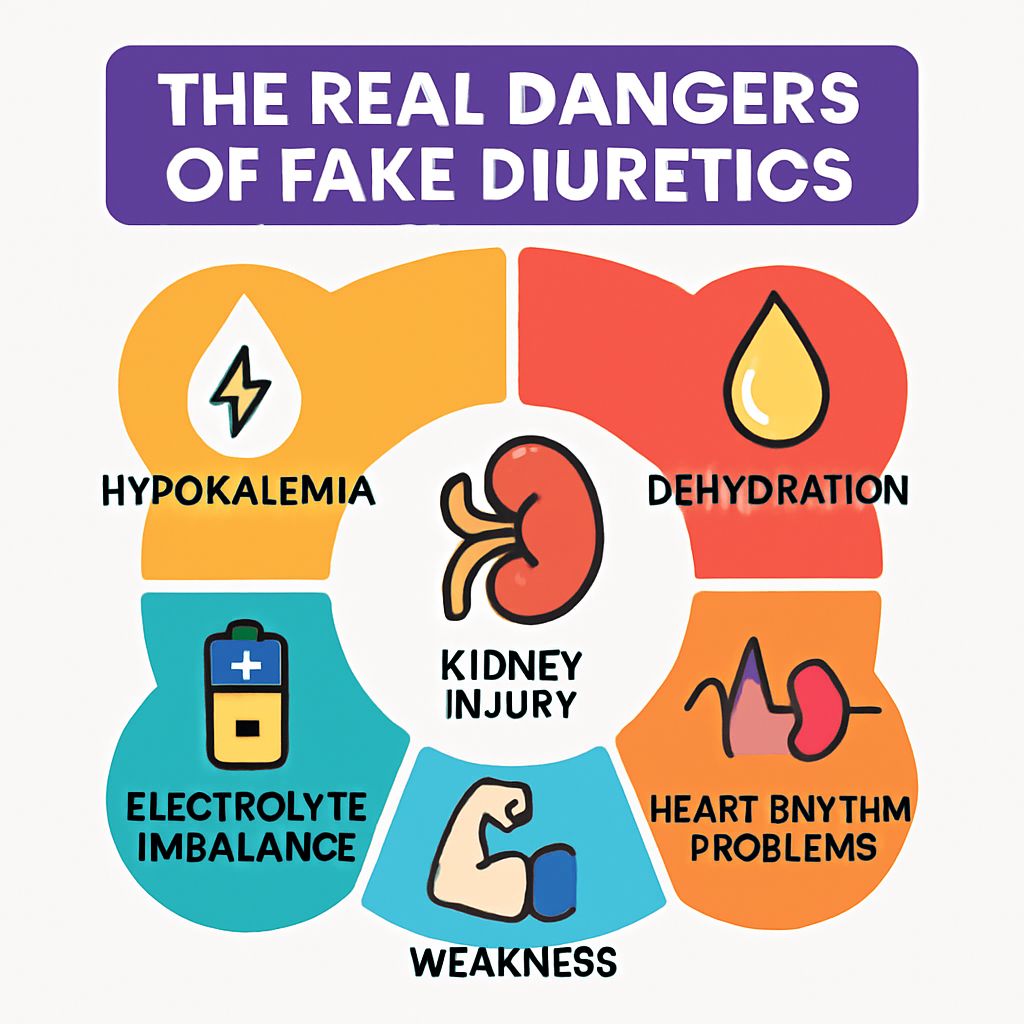
The Real Dangers of Fake Diuretics
The risks attached to fake diuretic products are not hypothetical — they are documented, serious, and in some cases irreversible. Beyond the obvious financial loss, consumers who rely on unregulated diuretic products face genuine physiological consequences that can escalate quickly, particularly in people who are already managing health conditions or taking prescription medications.
Electrolyte Imbalances From Unregulated Products
Your body maintains a tightly regulated balance of electrolytes — sodium, potassium, magnesium, and chloride — that governs everything from muscle function to heart rhythm. Any substance that meaningfully increases urination disrupts this balance, because electrolytes leave the body through urine. This is why physicians monitor electrolyte levels in patients on prescription diuretics. When a fake or unregulated product causes increased urination — whether through hidden pharmaceutical compounds, high caffeine doses, or genuinely active herbal ingredients used at excessive amounts — that same electrolyte depletion occurs without any monitoring in place. Learn more about the risks of using unregulated diuretics.
The consequences of severe electrolyte imbalance include muscle cramps, heart palpitations, extreme fatigue, confusion, and in serious cases, cardiac arrhythmia. Hypokalemia — dangerously low potassium — is one of the most common complications of unmonitored diuretic use and can develop surprisingly quickly. For people with pre-existing heart conditions or those on medications that already affect potassium levels, an unregulated product causing diuresis is not just ineffective — it is a genuine medical risk. If you are working on weight management and want a body composition approach that does not carry these risks, understanding options like Natural GLP-1 Enhancement Without Needles, Prescriptions Or Side Effects provides a safer path that works with your body’s chemistry rather than disrupting it.
Financial Loss and No Refund Policies
The financial dimension of fake diuretic scams is significant and deliberately engineered. Many of these products are sold through subscription auto-ship programs that are straightforward to sign up for and extraordinarily difficult to cancel. Consumers report being charged repeatedly after cancellation requests, receiving products after cancellation confirmations, and being told their return window had already closed by the time they realized the product was not working. The Better Business Bureau consistently lists supplement companies — including many in the diuretic and water pill category — among the top complaint categories for billing and refund issues.
Protect Yourself: What to Do If You’ve Been Scammed
If you have already purchased a fake diuretic product and believe you have been scammed, you have more recourse than most people realize. Acting quickly matters because some reporting windows are time-sensitive, and the sooner complaints are filed, the more likely regulatory attention follows. For more information on diuretics, consider reading this guide to over-the-counter diuretics.
Start by documenting everything — screenshots of the product website, your order confirmation, any email correspondence, and your bank or credit card statements showing the charges. This documentation is the foundation of any dispute or report you file. Then take the following steps in order of immediacy.
- Contact your bank or credit card company immediately and dispute the charge as an unauthorized or fraudulent transaction — many issuers will reverse charges for products that did not perform as advertised
- File a complaint with the Federal Trade Commission (FTC) at reportfraud.ftc.gov — the FTC uses these reports to identify patterns and take enforcement action against scam operators
- Report the product to the FDA’s MedWatch program at fda.gov/safety/medwatch if you experienced any adverse health effects, even mild ones
- Submit a complaint to the Better Business Bureau at bbb.org — while the BBB cannot force refunds, a formal complaint often prompts a response from the company and creates a public record
- If the product was purchased on Amazon, eBay, or another third-party marketplace, report the seller directly through the platform’s fraud reporting system
- Leave an honest, factual review on independent platforms like Trustpilot to warn other consumers
For anyone concerned about body sculpting or reducing the appearance of stubborn areas without relying on potentially dangerous water pill scams, it is worth exploring evidence-based alternatives. Reading about DIY Body Sculpting Cream Results: Enhance with Exercise Techniques and Tips provides practical, lower-risk approaches to body composition goals that do not involve manipulating fluid balance with unregulated products.

Frequently Asked Questions
These are the questions consumers most commonly ask when trying to navigate the confusing and often deceptive world of diuretic products. The answers are straightforward and grounded in what the evidence actually shows.
Are all herbal diuretics considered scams?
Not all herbal diuretics are scams — but the gap between what some herbs can do and what products containing them claim to do is often enormous. Dandelion leaf extract has demonstrated a mild, short-term diuretic effect in preliminary human research. Green tea, caffeine-containing herbs, and certain vegetables like asparagus also show some evidence of modestly increasing urine output. The problem is not the ingredients themselves — it is the claims attached to them.
A product using dandelion extract at a clinically plausible dose, with transparent labeling, realistic claims, and third-party testing, occupies a very different category than a product using the same ingredient to claim prescription-equivalent diuretic power, dramatic weight loss, or medical-grade detoxification. The ingredient alone does not define whether a product is a scam — the claims, the dosing transparency, and the verification behind it do. For more information on natural diuretics, check out this Healthline article.
A quick reference for evaluating herbal diuretic claims:
Ingredient Evidence Level Realistic Effect Common Scam Claim Dandelion Leaf Extract Preliminary human study Mild, short-term increased urination “Powerful kidney detox and rapid weight loss” Green Tea Extract Modest evidence, largely caffeine-driven Mild diuretic via caffeine content “Burns fat and flushes toxins simultaneously” Juniper Berry Traditional use, minimal clinical data Unproven in controlled human trials “Clinically proven urinary tract flush” Horsetail Extract Very limited human research Unclear, inconsistent findings “Medical-grade diuretic support” Caffeine (pure) Well-documented mild diuretic Tolerance builds quickly in regular users “Advanced diuretic matrix for daily water loss”
The table above illustrates the consistent pattern in fake diuretic marketing: take an ingredient with limited or mild evidence and attach claims that the research does not remotely support. Matching the ingredient to the realistic evidence level is one of the fastest ways to identify whether a product’s claims are grounded in reality.
Can OTC diuretics really help with weight loss?
No — not in any meaningful or lasting way. The only FDA-approved OTC diuretic, pamabrom (Diurex), is indicated specifically for temporary bloating and water retention associated with the menstrual cycle. Any weight lost while taking it is fluid weight that returns to baseline within 24 to 48 hours of normal hydration. There is no OTC diuretic — herbal, pharmaceutical, or otherwise — that causes fat loss. Genuine weight loss requires caloric management, metabolic changes, and consistency over time. Similarly, for those exploring long-term results in body contouring, understanding How To Maintain Cryolipolysis Results: Tips and Methods demonstrates what evidence-based, sustained body composition management actually looks like — and how different it is from anything a water pill can deliver.
How do I report a fake diuretic product?
You can report fake or fraudulent diuretic products through several official channels. The FDA’s MedWatch program (fda.gov/safety/medwatch) handles adverse event reports and product complaints. The FTC’s fraud reporting portal (reportfraud.ftc.gov) is the primary destination for marketing fraud and deceptive business practice complaints. If you purchased through an online retailer, the platform’s own seller reporting system is also an important step. Filing through multiple channels simultaneously increases the likelihood that regulatory attention follows.
What is the only FDA-approved OTC diuretic available?
Pamabrom, most commonly sold under the brand name Diurex, is the only FDA-approved over-the-counter diuretic in the United States. It is available in 50-milligram capsules and is intended for short-term relief of bloating, puffiness, and water retention related to the menstrual cycle. It should be taken with a full glass of water, and users should maintain adequate hydration throughout the day while using it.
Any OTC product claiming stronger, broader, or more dramatic diuretic effects than pamabrom — without a prescription or FDA drug approval — is either misrepresenting its capabilities, operating as an unregulated supplement making unsubstantiated drug claims, or in the worst cases, containing undisclosed pharmaceutical ingredients that have not been disclosed on the label. Pamabrom is the benchmark. Anything claiming to exceed it in the OTC space should be treated with serious skepticism.
Is it safe to use natural diuretics alongside prescription medication?
- Natural diuretics — including herbal supplements, teas, and food-based options — can interact with prescription medications in ways that are not always predictable or well-studied
- Combining herbal diuretics with prescription diuretics can amplify fluid and electrolyte loss beyond safe levels, increasing the risk of hypokalemia and dehydration
- Dandelion extract may interact with lithium, as increased urination can raise lithium concentrations in the blood to potentially toxic levels
- Green tea extract at high doses can interact with blood thinners, blood pressure medications, and certain heart medications
- Anyone taking a prescription diuretic, blood pressure medication, heart medication, or kidney-related treatment should consult their prescribing physician before adding any supplement with claimed diuretic properties
The most important rule here is that “natural” does not mean “safe to combine with everything.” Interactions between herbal compounds and pharmaceutical drugs are real, documented, and sometimes serious. Your pharmacist is an excellent and often underutilized resource for checking supplement-drug interactions — most will review your current medication list against any supplement you are considering, at no cost.
The broader takeaway from the entire fake diuretics landscape is this: the more dramatic the claim, the more skepticism it deserves. Real medical tools — the ones that actually alter fluid balance, kidney function, or body composition — require oversight, monitoring, and clinical evidence behind them. Supplements that promise the same results without any of that infrastructure are not cutting corners on safety because it saves money. They are doing it because oversight would expose the fact that the product does not work. Another good source of information that can be used in conjunction with this is our article on Intermittent Fasting Program Success Stories and Fast Results.
Protecting yourself starts with understanding what legitimate diuretics actually do, recognizing the specific language patterns scam products use, verifying any product through the FDA database and third-party testing records before purchasing, and reporting products that have already caused you harm. These steps cost nothing and can prevent both financial loss and genuine health risks.